



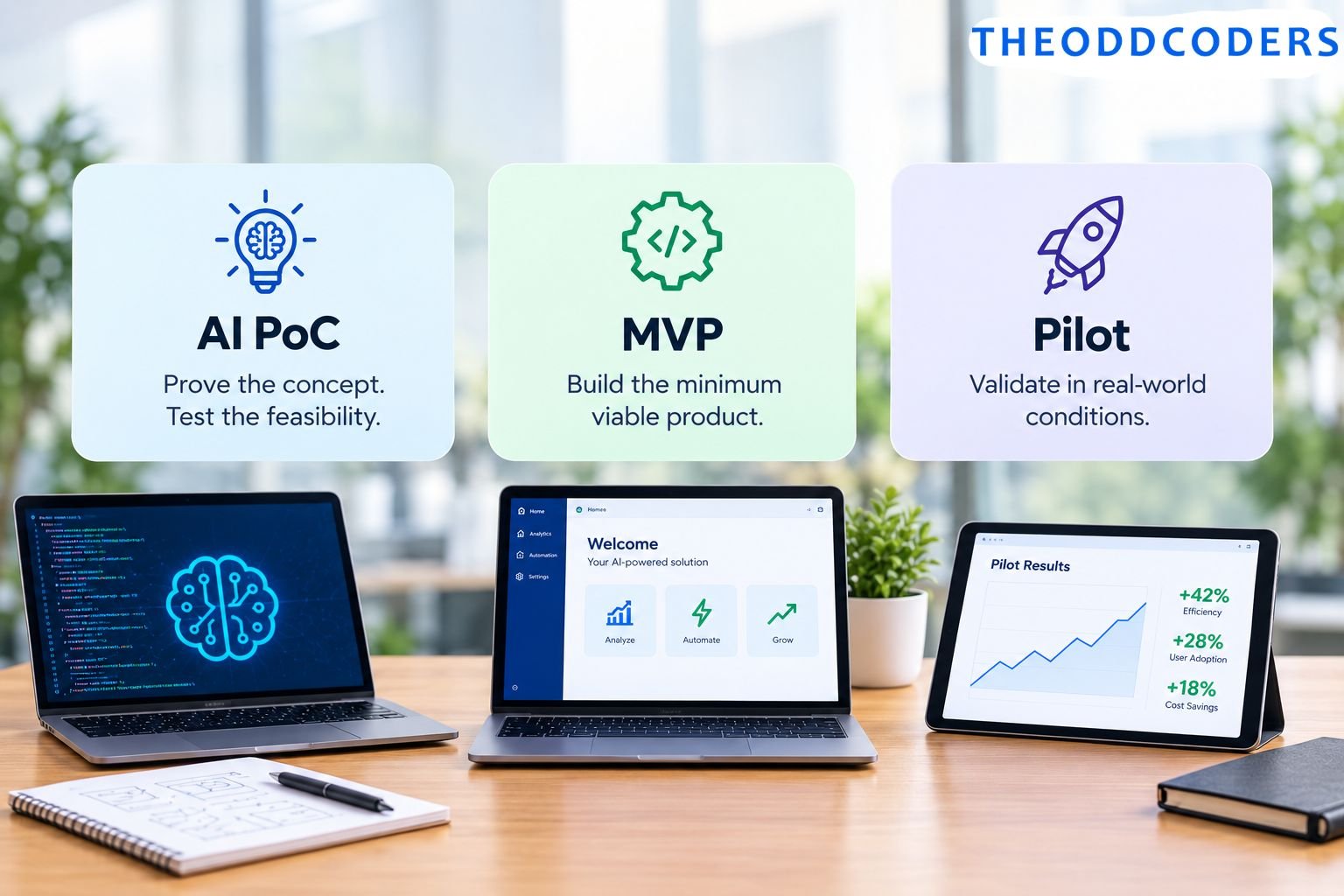
Businesses exploring artificial intelligence often face an important decision before development begins: should they build a proof of concept (PoC), a minimum viable product (MVP), or a pilot? Although these approaches are related, each serves a different purpose in validating an AI solution.
An AI proof of concept tests whether an idea is technically feasible, an MVP tests whether a usable product delivers value to users, and a pilot evaluates how a solution performs in a real or controlled business environment. Choosing the right approach helps businesses manage development costs, identify risks, and make better investment decisions.
Working with an experienced AI Software Development Company can help organisations identify their biggest uncertainties and choose a practical development strategy. Instead of building a complete AI system immediately, businesses can validate key assumptions, gather evidence, and improve their solution in stages.
Understanding the Three Approaches to AI Development
A PoC, MVP, and pilot are different ways to test an idea before committing to broader implementation. The main difference is the question each approach is designed to answer.
What Is an AI Proof of Concept (PoC)?
An AI proof of concept is a small experiment designed to determine whether a proposed AI solution can work technically. It focuses on a specific assumption, challenge, or capability rather than delivering a complete product.
For example, a retail company might want to use AI to predict product demand. Before building an entire forecasting application, the team could test whether historical sales data provides useful predictions.
An AI PoC typically focuses on:
- Testing technical feasibility and model performance.
- Checking whether suitable data is available.
- Evaluating a proposed AI approach or technology.
- Identifying technical limitations and potential risks.
- Determining whether further investment is justified.
An AI PoC Development Company can help define the experiment, select an appropriate approach, and establish measurable criteria for deciding whether the concept is worth pursuing.
The result is evidence about feasibility, not necessarily a product that customers can use. A successful PoC may still require substantial engineering, security, integration, and testing before deployment.
Interesting Read : What is an AI Proof of Concept (PoC)
What Is a Minimum Viable Product (MVP)?
A minimum viable product is an early, usable version of a product that includes the essential features needed to deliver value and collect feedback from real users.
Unlike a PoC, which primarily tests whether an AI approach can work, an MVP explores whether the proposed solution addresses a genuine user or business need.
For example, after validating an AI demand-forecasting model, a business might build a simple dashboard that allows selected employees to view predictions, compare them with historical sales, and provide feedback.
An AI MVP may include:
- A focused set of core features.
- A usable interface or application workflow.
- Necessary integrations with relevant systems.
- Basic monitoring and appropriate safeguards.
- Feedback mechanisms to measure usefulness and identify improvements.
Businesses seeking MVP Development Services should define the smallest set of features that can deliver meaningful value without unnecessary complexity.
An MVP is not simply an unfinished product. It should be usable for its intended purpose, with safeguards appropriate to its users, data, and operating environment.
Interesting Read : MVP Development: A Step-by-Step Guide
What Is an AI Pilot?
An AI pilot is a limited trial designed to evaluate a solution under realistic operating conditions. It helps determine whether the technology fits existing workflows and performs reliably for a defined group of users.
Consider a customer support team testing an AI assistant that suggests responses to incoming questions. A pilot might introduce the assistant to a small group of support agents, monitor response quality, and measure whether it improves their workflow.
An AI pilot generally evaluates:
- Performance with realistic data and workloads.
- Compatibility with existing business processes.
- User experience and adoption.
- Reliability, security, and operational risks.
- The resources required for wider deployment.
A pilot can use an existing solution, a PoC that has been strengthened, or an MVP. The precise scope depends on what the organisation needs to validate.
The key objective is to gather operational evidence before expanding the solution to more users, teams, or business processes.
AI PoC vs MVP vs Pilot: Key Differences
The following comparison highlights how the three approaches differ in purpose, scope, and expected outcomes.
| Comparison Factor | AI PoC | AI MVP | AI Pilot |
|---|---|---|---|
| Main objective | Validate technical feasibility | Validate user and business value | Validate operational performance |
| Primary question | Can it work? | Is it useful? | Does it work in our environment? |
| Scope | Narrow experiment | Essential product features | Limited real-world deployment |
| Typical audience | Technical team and subject experts | Early users or target customers | Selected employees or customers |
| Technical focus | Model capability and data feasibility | Usability, functionality, and feedback | Reliability, integration, and workflow fit |
| Success measures | Accuracy, quality, latency, and feasibility | Engagement, task completion, and user feedback | Reliability, adoption, business impact, and cost |
| Main outcome | Evidence for a development decision | A usable early product | Evidence for wider implementation |
These distinctions are useful guidelines rather than universal rules. Some projects combine stages, while others skip a stage when the required evidence already exists.
The most effective approach is to choose the smallest practical development effort that answers the most important unanswered question.
When Should You Choose a PoC, MVP, or Pilot?
The right choice depends on the maturity of your idea, the risks involved, and what you need to learn next.
Choose a PoC When Technical Feasibility Is Uncertain
Start with a PoC if your project depends on an AI capability that has not been validated in your specific business context.
This is particularly useful when:
- You are unsure whether your data is suitable for the task.
- The required model performance is uncertain.
- You need to compare AI approaches before selecting one.
- Integration with an existing system may present technical challenges.
For example, a manufacturing company could test whether computer vision can identify specific defects in product images before investing in a full inspection application.
The PoC should have a clear scope and measurable exit criteria. If the approach fails to meet those criteria, the team can revise the method, investigate alternatives, or stop the project before making a larger commitment.
Choose an MVP When You Need User Feedback
An MVP is appropriate when the core technology is sufficiently understood, and you need to learn whether people will use the proposed solution.
Consider an AI-powered document assistant. After confirming that it can retrieve relevant information from company documents, the team could create a basic application for employees to search policies and ask questions.
The MVP would help answer questions such as:
- Can users complete their tasks more efficiently?
- Are the responses useful and sufficiently reliable?
- Which features do users need most?
- Is the solution valuable enough to justify further investment?
At this stage, prioritise the essential user journey instead of developing every feature on the product roadmap.
Choose a Pilot When Real-World Performance Matters
A pilot is suitable when the solution needs to be evaluated within actual workflows before a broader rollout.
For example, a logistics company might test an AI route-planning system with a limited number of delivery vehicles. The trial could evaluate route recommendations, integration with dispatch operations, driver feedback, and operational costs.
Before starting, define the pilot group, duration, monitoring process, and success criteria. Also establish how the team will respond if the system produces unreliable recommendations or disrupts normal operations.
A successful pilot provides stronger evidence of operational readiness, but it does not automatically guarantee that the solution will perform equally well at a larger scale.
How an AI Software Development Company Can Help
Choosing between these approaches is only one part of an AI project. Businesses must also decide how to handle data, select technologies, measure results, and prepare for future deployment.
An experienced Software Development Company in India can help structure these decisions around the business problem rather than starting with technology alone.
The development process may include:
- Requirement discovery: Define the business problem, target users, expected outcome, and project constraints.
- Feasibility assessment: Evaluate data availability, technical requirements, model suitability, and key risks.
- Approach selection: Decide whether a PoC, MVP, or pilot best addresses the current uncertainty.
- Development and testing: Build the agreed solution and evaluate it against predefined criteria.
- Performance evaluation: Review output quality, usability, latency, costs, and other relevant measures.
- Next-step planning: Use the findings to decide whether to improve, expand, deploy, or discontinue the project.
An experienced team should also consider data privacy, security, human oversight, monitoring, and ongoing maintenance when those requirements apply.
The aim is to make informed decisions at each stage, not to build more software than the business currently needs.
What Factors Affect AI PoC, MVP, and Pilot Development Costs?
The cost of an AI project depends on its scope and complexity, not simply on whether it is called a PoC, MVP, or pilot.
Important cost factors include:
- Data readiness: Incomplete, inconsistent, or poorly structured data may require additional preparation.
- AI complexity: A straightforward model integration may require less work than a custom model or multi-step AI agent.
- Integration requirements: Connecting with CRM platforms, ERP systems, databases, or other business tools can add development effort.
- Security and compliance: Sensitive data and regulated workflows may require additional safeguards and review.
- User experience: A limited experiment generally needs less interface development than a usable product.
- Testing and monitoring: Real-world trials may require more extensive reliability, performance, and operational testing.
A PoC is often the smallest initial investment, but that is not guaranteed. A difficult technical experiment can be expensive, while an MVP using proven technology may be relatively straightforward.
Businesses comparing an AI PoC Development Company with a broader development partner should ask for a defined scope, deliverables, evaluation criteria, and a clear explanation of what is excluded.
Why Should You Avoid Skipping Validation?
Moving directly into full development can be reasonable when feasibility and requirements are already well understood. However, skipping validation when major uncertainties remain can increase the risk of wasted effort.
For example, building a complete AI application before testing whether its model can produce sufficiently reliable outputs may lead to expensive redesigns later.
A staged approach can help teams:
- Identify technical problems earlier.
- Prioritise the features users actually need.
- Estimate operational costs more realistically.
- Collect evidence before expanding the project.
- Make better decisions about continued investment.
The objective is not to create three separate projects by default. It is to use each stage only when it provides useful evidence.
How to Choose the Right AI Development Partner
Selecting the right development partner is important because the quality of early validation can influence the decisions that follow.
When evaluating an AI Software Development Company, consider the following:
1. Problem-solving approach: Does the team understand your business objectives before recommending a technology?
2. Relevant technical capabilities: Can the team assess data readiness, model performance, integrations, and AI-specific risks?
3. Clear success criteria: Will the team define measurable outcomes before development begins?
4. Transparent project scope: Are deliverables, timelines, costs, assumptions, and exclusions clearly documented?
5. Security and maintainability: Does the proposed solution account for appropriate access controls, data handling, testing, and future maintenance?
6. A realistic growth plan: Can the team explain what would be required to move from an experiment to a usable product or broader deployment?
For businesses seeking a Software Development Company in India, location can be one consideration, alongside technical expertise, communication, project management, and the ability to support the solution over time.
The best partner is one that helps you understand the risks and trade-offs before recommending the next investment.
Conclusion
An AI PoC, MVP, and pilot serve different purposes, but they share one goal: helping businesses make better decisions before committing to wider implementation.
Choose a PoC when technical feasibility is uncertain, an MVP when you need to validate product value with users, and a pilot when you need evidence about real-world performance and operational fit. These approaches do not always need to follow a fixed sequence.
If you are planning an AI initiative, working with an experienced AI Software Development Company can help you identify the biggest risks, define measurable success criteria, and select a practical path from initial idea to implementation.
The best starting point is not necessarily the most advanced solution. It is the one that answers your most important question with the least unnecessary complexity.
Frequently Asked Questions
1. Is an AI PoC the Same as an MVP?
No. An AI PoC tests whether a particular technical approach is feasible, while an MVP is a usable early version of a product designed to gather feedback and evaluate its value to users.
2. Can an AI Pilot Be Conducted Before Building an MVP?
Yes. The sequence depends on the project. A pilot can evaluate an existing solution or a limited implementation before an organisation commits to developing a broader product. However, a pilot that tests a new product with real users may require some MVP-like functionality.
3. How Long Does AI PoC, MVP, or Pilot Development Take?
There is no universal timeline. A narrowly scoped PoC may take less time than a feature-rich MVP or a pilot involving multiple systems. Data preparation, technical complexity, integrations, testing, and approval requirements all affect the schedule.
4. What Should an AI PoC Demonstrate Before Moving Forward?
It should provide evidence that the proposed approach can meet defined technical and business requirements. Depending on the project, these may include output quality, data suitability, latency, cost per task, and key security or feasibility constraints.
5. Are MVP Development Services Suitable for Startups?
Yes. MVP development can help startups test a focused product concept with early users before investing in a larger feature set. The MVP should still be reliable and safe enough for its intended use.
6. Why Work With an AI Software Development Company?
A specialised development partner can help assess feasibility, plan the right development stage, build and evaluate the solution, and identify the work needed before broader deployment. The right engagement depends on the business problem and the team’s existing capabilities.
