



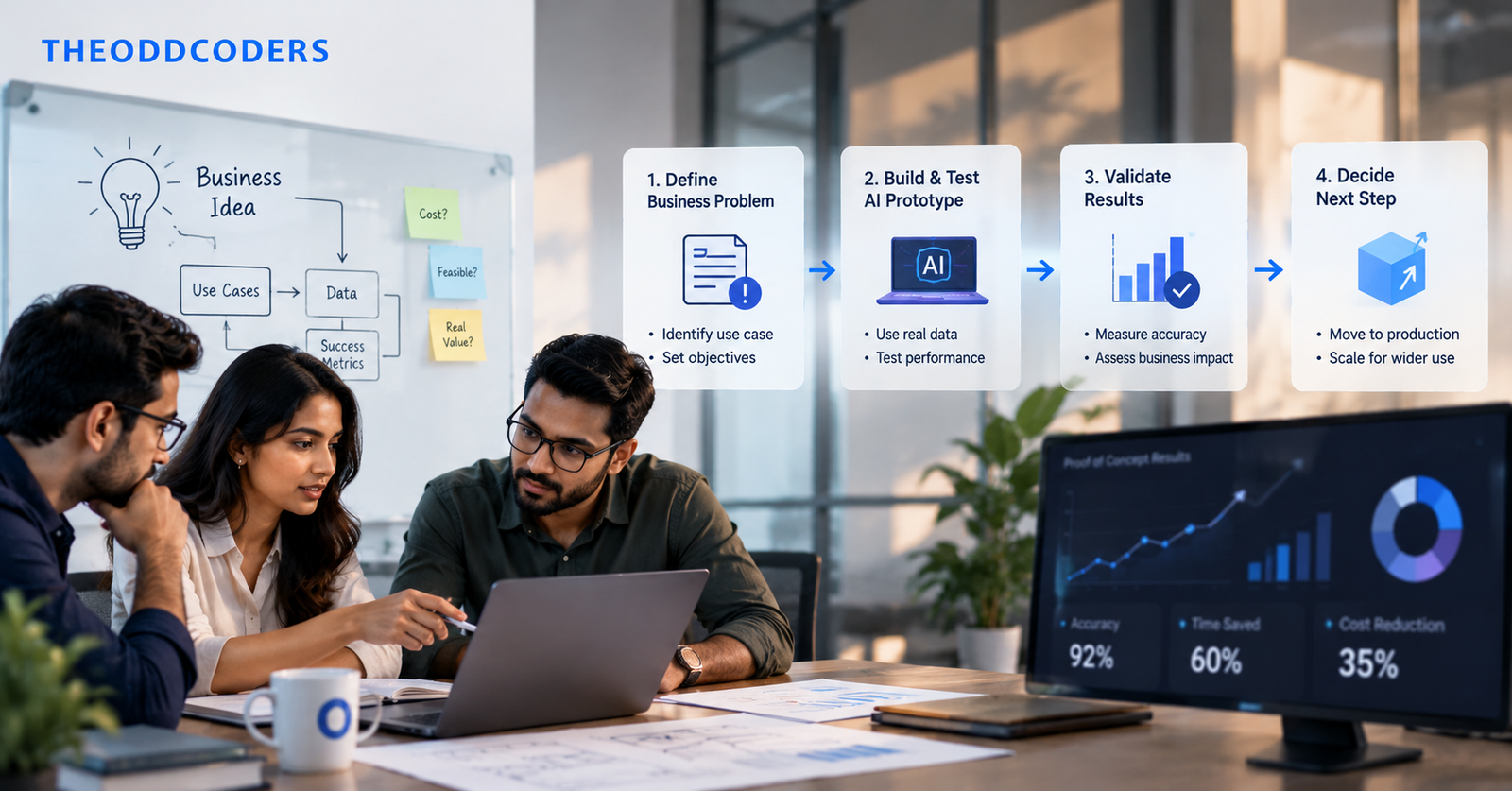
An artificial intelligence idea can sound promising on paper, but that does not guarantee it will work with your business data, fit your existing systems, or deliver measurable value. Before investing in a complete AI product, businesses need a practical way to test whether the idea is technically feasible and worth pursuing.
That is where AI PoC development comes in. An AI proof of concept (PoC) is a small, focused experiment that tests whether a proposed AI solution can solve a specific problem under defined conditions. It helps businesses evaluate technical feasibility, data readiness, expected performance, and potential business value before committing to full-scale development.
For example, a retailer planning an AI-powered demand forecasting system might test whether historical sales data can produce useful predictions for selected products. The business can assess the results before building a forecasting platform for its entire inventory.
This guide explains how an AI PoC works, when to build one, what it costs, and how to use its findings to make a confident development decision.
What is an AI Proof of Concept?
An AI proof of concept is a limited implementation that tests whether an AI-based idea is practical and can meet specific requirements. It focuses on answering a few key questions rather than delivering a complete, production-ready application.
An AI PoC may use a machine learning model, a large language model (LLM), computer vision, natural language processing, or another AI technique. The appropriate approach depends on the business problem being tested.
A well-defined PoC typically establishes:
- The problem: What business challenge should the AI solution address?
- The hypothesis: What do you expect the AI system to accomplish?
- The data: Is the necessary information available, relevant, and usable?
- The evaluation criteria: How will you measure the results?
- The limitations: What will the experiment not attempt to prove?
The objective is to collect enough evidence to decide whether to proceed, revise the approach, or stop.
A PoC is not a guarantee that a finished AI product will succeed. Its results apply to the specific data, conditions, and scope tested. Production deployment introduces additional considerations, including security, scalability, integration, monitoring, and ongoing maintenance.
Why Should Businesses Build an AI PoC First?
Developing a complete AI solution without validating its core assumptions can lead to avoidable expenses and delays. A PoC helps businesses identify important obstacles while the project is still small enough to change direction.
1. Validate Technical Feasibility
An AI idea may depend on capabilities that are difficult to achieve with the available data or technology.
For example, a company might want an AI system to classify incoming support tickets automatically. A PoC can test whether a model can distinguish billing questions, technical problems, refund requests, and other categories with acceptable reliability.
If the results are inconsistent, the team can investigate better training examples, a different model, clearer categories, or a simpler rule-based approach.
This is more useful than discovering the same limitation after building an entire application around the model.
2. Evaluate Data Readiness
AI systems depend on the quality, relevance, and availability of their inputs. Even a capable model may perform poorly when the source data is incomplete, outdated, inconsistent, or poorly labeled.
A PoC can reveal whether the business has enough representative data to test its idea. It can also expose missing fields, duplicate records, inconsistent terminology, and privacy restrictions.
For generative AI applications, the team may need to evaluate document quality, retrieval methods, source attribution, and the risk of unsupported answers.
Identifying these issues early helps establish a realistic data preparation plan.
3. Reduce Investment Uncertainty
A full AI project can involve software engineering, model development, data preparation, infrastructure, integration, and testing. Committing to all these activities before validating the main technical assumption creates financial risk.
AI PoC Development narrows that uncertainty by limiting the initial scope.
The result may support further investment, but it may also show that the expected benefits are too small, the data is unsuitable, or a non-AI solution would be more appropriate.
A useful PoC provides evidence for a decision, not simply a demonstration that makes an idea look impressive.
4. Measure Business Value
Technical performance alone does not establish whether an AI solution is worth building.
A model that classifies documents accurately may still offer limited value if employees spend more time reviewing its output than they previously spent doing the task manually.
Before starting, define a business metric such as:
- Time required to complete a task.
- Percentage of cases handled without manual intervention.
- Error rate compared with the existing process.
- Cost per processed transaction.
- Improvement in forecast accuracy.
- Reduction in repetitive administrative work.
Where possible, compare the PoC against a documented baseline. This helps distinguish measurable improvement from an impression that the AI system is useful.
5. Identify Risks Before Deployment
An AI experiment can uncover risks involving privacy, security, bias, inaccurate outputs, and human oversight.
For instance, a hiring-related AI tool may produce different results for different groups, while a customer-facing chatbot may generate incorrect information. These risks require evaluation before the system influences important decisions.
The National Institute of Standards and Technology (NIST) provides an
AI Risk Management Framework that discusses trustworthy AI characteristics, including validity, reliability, safety, security, accountability, transparency, and fairness. These considerations should inform the PoC and continue throughout the system’s lifecycle.
Interesting Read: Can Ai Transform Your Business? Here’s How to Find Out
What is the Difference Between an AI PoC, Prototype, and MVP?
These three approaches serve different purposes. Choosing the right one depends on the uncertainty a business needs to resolve.
| Approach | Main purpose | Typical output | Key question |
| AI proof of concept (PoC) | Test feasibility and core assumptions | A limited experiment with measured results | Can this work under the conditions tested? |
| Prototype | Explore design, workflow, or interaction | A mockup or early interactive model | Will users understand and use this approach? |
| Minimum viable product (MVP) | Deliver a usable product with a limited feature set | A working product for initial users | Does this product provide enough value to justify further development? |
An AI PoC may have little or no user interface. A prototype may simulate AI behavior without using a real model. An MVP generally needs enough functionality and reliability to serve its intended users, although the exact requirements depend on the product.
These approaches can overlap. For example, a team may build a small AI experiment first, create an interactive prototype to test the workflow, and then develop an MVP.
However, this sequence is not mandatory. If the main uncertainty concerns user experience rather than model feasibility, a prototype may be the better first step.
When Does an AI PoC Make Sense?
A proof of concept is particularly useful when a project contains a major technical, data-related, or business uncertainty that could materially affect the investment decision.
1. Generative AI and intelligent assistants
A business planning an internal knowledge assistant can test whether a language model retrieves relevant information from company documents and produces answers grounded in those sources.
The PoC should examine not only answer quality but also incorrect answers, missing information, access permissions, and whether users can verify the supporting sources.
2. Predictive analytics and forecasting
A logistics company might investigate whether historical shipment data can help predict delays. A limited experiment can compare model predictions with actual outcomes using a suitable evaluation method.
The team should also check whether the model works across different routes, seasons, and shipment types rather than relying on a single favorable sample.
3. Computer vision and image recognition
A manufacturer may want to identify product defects using camera images. A PoC can test whether available images are sufficiently representative and whether the model can identify the defects that matter operationally.
Lighting changes, camera placement, rare defect types, and differences between production lines can affect performance.
4. Business process automation
A company may want to extract information from invoices, categorize emails, or route service requests automatically.
A PoC can measure extraction accuracy, exception rates, and the amount of manual review still required. It can also determine whether conventional automation would solve the problem more simply.
5. When you may not need a PoC
Not every software project requires a separate AI experiment. If the functionality is well understood, the technology is established, and the main uncertainty concerns implementation, a small development task or conventional prototype may be sufficient.
Likewise, if the proposed task can be handled reliably using existing software or straightforward business rules, introducing AI may add unnecessary complexity.
The goal is not to build a PoC for every idea. It is to validate the assumptions that matter most.
How Does AI PoC Development Work?
A successful PoC starts with a business question and ends with an evidence-based recommendation. The following process provides a practical structure.
Step 1: Define the Business Problem
Begin by describing the problem in operational terms rather than simply naming an AI technology.
Instead of saying, “We need a generative AI solution,” define the objective as, “We want to reduce the time employees spend finding answers in internal policy documents.”
Document the current process, the people affected, the existing limitations, and the outcome that would justify further investment.
A narrow problem makes the experiment easier to evaluate.
Step 2: Write a Testable Hypothesis
Turn the business objective into a statement that can be evaluated.
For example: “Using AI to categorize support tickets will reduce manual sorting time while maintaining an acceptable classification error rate.”
Next, define measurable success criteria. These might include processing time, classification precision, recall, cost per ticket, or the percentage of cases requiring human review.
The correct thresholds depend on the business context. A low-risk internal categorization tool may tolerate different error rates from a system that influences financial or healthcare decisions.
Step 3: Assess Data and Technical Requirements
Identify the datasets, documents, APIs, infrastructure, and integrations required for the experiment.
Evaluate whether the data represents real operating conditions and whether the team has permission to use it. Remove or protect sensitive information where necessary.
At this stage, the team should also compare possible approaches. Depending on the use case, options may include:
- Existing AI models accessed through an API.
- Open-source models.
- Fine-tuning a model for a specialized task.
- Retrieval-augmented generation (RAG), which combines a language model with relevant external information.
- Conventional software rules or statistical methods.
A custom-trained model is not automatically the best option. Reusing an existing model or combining AI with conventional software may meet the requirements with less complexity.
Step 4: Build the Smallest Useful Experiment
Develop only what is necessary to test the hypothesis.
A PoC might include a data preparation pipeline, a model or API connection, a simple interface, an evaluation script, and a limited set of sample cases. It usually does not need every feature intended for the final product.
Keep the scope controlled so that the team can identify which factors influence the results.
For example, an initial document assistant might work with a selected collection of approved documents rather than connecting to every company system.
Step 5: Test Against Realistic Conditions
Evaluate the experiment using representative data that was not simply selected because it produces favorable results.
Depending on the application, testing may include:
- Accuracy and error analysis.
- Precision and recall for classification tasks.
- Hallucination and source-grounding checks for generative AI.
- Performance across relevant user groups or data categories.
- Response time and estimated operating cost.
- Security, privacy, and access-control checks.
For machine learning tasks, separate training data from evaluation data where appropriate. For generative AI, create a consistent test set with expected answers or evaluation criteria.
Record failures as carefully as successful outputs. A model’s limitations are part of the evidence needed to decide whether the idea is viable.
Step 6: Review the Business Results
Compare the measured results with the baseline and the success criteria defined at the beginning.
Consider the complete workflow, including human review, integration effort, infrastructure, and ongoing operating costs. A model may perform well in isolation but provide little overall benefit if it creates extra work elsewhere.
The findings should explain what worked, what did not, which assumptions remain untested, and what additional investment would be needed for production.
Step 7: Decide What Happens Next
At the end of the experiment, choose one of three paths:
- Proceed: The results meet the agreed criteria, and the remaining production risks appear manageable.
- Revise: The idea still has potential, but the team needs better data, a different model, revised requirements, or another focused test.
- Stop: The results do not justify further investment, or a simpler alternative offers better value.
Stopping after an unsuccessful PoC can be a good business outcome if it prevents a much larger investment in an unsuitable solution.
Interesting Read: Agentic AI: Your Proactive Digital Co-Worker
A Practical Example of an AI PoC
Hypothetical scenario: A growing online business wants to introduce an AI assistant to answer customer questions about product specifications, delivery policies, and returns. Building a complete customer service platform immediately would require careful decisions about AI model selection, data access, system integration, security, user experience, and human escalation. Instead, the business can begin with a limited proof of concept (PoC) to test the AI assistant’s capabilities and evaluate its feasibility before investing in full-scale development.
Instead, the company starts with a limited PoC to test the AI assistant’s capabilities, identify potential challenges, and evaluate its effectiveness before investing in full-scale development.
Objective: Determine whether an AI assistant can answer common questions using approved company documents.
Scope: A selected set of product information, delivery policies, and return guidelines.
Evaluation: A test set covering common questions, ambiguous requests, missing information, and questions outside the approved knowledge base.
Measurements: Answer correctness, whether claims are supported by the source documents, response time, estimated cost, and the frequency of answers that require human intervention.
Decision: If the results meet the agreed criteria, the business can investigate a pilot with limited users. If answers are unreliable, it can improve document quality, adjust retrieval, change the model, or reconsider the use case.
This experiment does not prove that a full customer service platform will succeed at scale. It provides evidence about a specific capability and helps identify what needs to be tested next.
How Much Does AI PoC Development Cost?
There is no universal price for an AI proof of concept. The cost depends on the problem, available data, technical complexity, evaluation requirements, and experience of the development team.
The following factors usually have the greatest influence.
| Cost factor | Why it matters |
| Data preparation | Incomplete, inconsistent, or unstructured data may require significant cleaning and labeling. |
| Model selection | An existing model API may require less initial work than a specialized model that needs training or fine-tuning. |
| Integration | Connecting to company databases, APIs, or legacy systems increases engineering effort. |
| Evaluation | Reliable testing requires representative examples, suitable metrics, and analysis of failures. |
| Security and compliance | Sensitive data and regulated workflows may require additional controls and reviews. |
| Infrastructure | Compute resources, storage, model usage, and monitoring can add costs during experimentation and later operation. |
A narrow PoC using clean sample data and an existing model may be relatively inexpensive compared with an experiment involving specialized computer vision, complex integrations, or sensitive enterprise data.
For a useful estimate, ask a development partner to define the scope, deliverables, assumptions, exclusions, testing plan, and expected operating costs before work begins. Avoid comparing quotes based only on the headline price when the proposed experiments test different things.
Also distinguish the initial development budget from the cost of running the finished solution. API usage, hosting, monitoring, data updates, and human review can create recurring expenses.
Common Mistakes to Avoid During an AI PoC
A proof of concept is useful only when its results support a realistic decision. These common mistakes can undermine that purpose.
1. Building a demo instead of testing a hypothesis
A polished interface or impressive demonstration does not establish technical feasibility. Start with the main uncertainty and build only enough functionality to test it.
2. Using unrepresentative data
A model can appear effective on a small, favorable sample and perform poorly in real conditions. Include edge cases, missing information, unusual inputs, and examples from different operating conditions.
3. Measuring only model accuracy
The business must also evaluate workflow impact, costs, reliability, and the amount of human oversight required. Choose metrics that reflect the actual task.
4. Ignoring privacy and security
Do not upload confidential company or customer information to an AI service without checking the provider’s data handling, access controls, contractual terms, and applicable requirements.
5. Expanding the scope too early
Adding more features during the experiment can increase costs and make the results harder to interpret. Keep the original test narrow and document additional ideas for later stages.
6. Assuming PoC results guarantee production success
A limited experiment cannot fully establish how a system will behave under heavy traffic, changing data, adversarial inputs, or long-term use. Production readiness requires further engineering, testing, and monitoring.
How to Choose an AI Development Partner
If your team lacks the necessary AI expertise, an experienced development partner can help define the experiment, select an appropriate technical approach, and evaluate the results.
When assessing an AI Development Company in India or another market, consider these questions:
- Problem definition: Can the team translate your business objective into a testable hypothesis?
- Technical judgment: Can it explain when to use an existing model, a custom model, RAG, or conventional software?
- Data expertise: Can it assess data quality, access permissions, and preparation requirements?
- Evaluation methods: Will it define success criteria and report failures as well as successful results?
- Security practices: Can it explain how sensitive data will be protected during development and testing?
- Transparent scope: Will you receive a clear statement of deliverables, assumptions, exclusions, and costs?
- Next-step planning: Can the team explain what a successful PoC would still require before production?
A capable Software Development Company should also understand how the experiment may eventually connect to application architecture, databases, APIs, authentication, monitoring, and maintenance.
Theoddecoders Technologies provides AI-related services covering areas such as AI consulting, generative AI, large language models, natural language processing, computer vision, and data analytics. Businesses evaluating a potential project can explore its AI development services in India and discuss which approach fits their requirements.
The right partner should be willing to recommend a smaller experiment—or even a non-AI solution—when that is the most practical option.
Final Recommendation: Validate Before You Scale
An AI proof of concept gives businesses a structured way to test whether an AI idea is technically feasible, supported by available data, and valuable enough to justify further investment.
The most effective approach is to start with one clearly defined problem, agree on measurable success criteria, test the idea under realistic conditions, and document both successful results and limitations. Use the evidence to decide whether to proceed, revise the solution, or choose a simpler alternative.
AI PoC Development should be treated as a decision-making exercise, not merely a technical demo. By validating the important assumptions first, businesses can plan their next development stage with a clearer understanding of the opportunities, costs, and risks.
If you are evaluating an AI initiative, Theoddecoders Technologies can be a starting point for exploring AI development services and discussing the technical requirements of your project.
Frequently Asked Questions
1. How long does an AI PoC take to develop?
The timeline depends on the scope, data readiness, integration requirements, and evaluation complexity. A narrow experiment using prepared data and an existing model may take considerably less time than one requiring extensive data preparation or specialized model development. Agree on milestones and deliverables before starting.
2. Is an AI PoC the same as an AI MVP?
No. A PoC primarily tests feasibility and key assumptions, while an MVP provides a limited but usable product for initial users. A PoC may be discarded after testing; an MVP generally requires a stronger focus on usability, reliability, and ongoing operation.
3. Do I need a large dataset to build an AI PoC?
Not always. The necessary data volume depends on the use case, model, and evaluation objective. An experiment using a pretrained model may need only a carefully selected evaluation set, whereas training a specialized model may require substantially more representative data. Small samples can also make results less reliable, so the limitations must be documented.
4. Can a startup build an AI PoC with a limited budget?
Yes. A startup can reduce initial effort by selecting one business problem, using existing models where appropriate, limiting integrations, and defining measurable success criteria. It should still budget for data preparation, testing, security, and any recurring model or infrastructure costs.
5. What happens if the AI PoC fails?
A failed PoC can reveal that the data is insufficient, the technology is unsuitable, the expected performance is unrealistic, or the business problem does not justify AI. The team can revise the hypothesis, test an alternative approach, use conventional automation, or stop the project. The value comes from learning before making a larger commitment.
6. Can a PoC be deployed directly to production?
Usually, a PoC should not be treated as production-ready without further assessment. Production deployment may require stronger security, scalable infrastructure, access controls, integration testing, monitoring, reliability checks, human oversight, and operational support. The exact requirements depend on the application and its risks.
